
First Human Test Application of the Aptamarker Platform
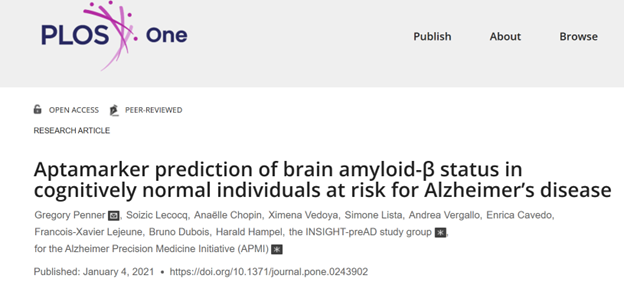
The first human test of the Aptamarker Platform demonstrated its ability to screen plasma for all possible biomarkers simultaneously. This milestone was highlighted in the study “Aptamarker prediction of brain amyloid-β status in cognitively normal individuals at risk for alzheimer’s disease.” The paper showed how the platform can be used for the prediction of brain amyloid-β accumulation in at-risk, cognitively normal individuals, marking a significant step forward in early disease detection. By analyzing proteins directly in human plasma, the Aptamarker Platform revealed insights that traditional biomarker approaches might miss, underscoring its transformative potential in human diagnostics and biomarker discovery.
Aptamarker prediction of brain amyloid-B status in cognitively normal individuals at risk for Alzheimer's disease
In this study, researchers focused on predicting brain amyloid-β deposition using plasma samples. Brain amyloid-β plaques represent a key risk factor for Alzheimer’s disease. Researchers compared cognitively normal individuals over the age of 70. Participants differed in the level of brain amyloid detected through PET scans in the INSIGHT study group.
Researchers performed positive selection using plasma from individuals with high brain amyloid levels. They performed negative selection using plasma from individuals with low brain amyloid levels. This approach enriched the aptamer library for relevant molecular signals. Researchers then applied the selected library to plasma samples from 22 individuals. Eleven individuals had high brain amyloid levels, and eleven had low levels.
Researchers used next-generation sequencing to analyze each selected library and measure the frequency of 10,000 aptamer sequences. They then evaluated these sequences using sparse partial least squares discriminant analysis. This analysis aimed to identify sequences that explained variation in brain amyloid deposition.
The analysis identified a subset of 44 aptamers. Researchers synthesized these aptamers individually. They then applied the aptamer panel to plasma samples from 70 cognitively normal individuals over the age of 70. Fifty-four samples formed the training set, while fifteen samples formed the test set. The model misclassified three individuals in the test set. Overall, the model achieved 80% accuracy, with 86% sensitivity and 75% specificity.
These aptamers function directly as biomarkers. For this reason, researchers call them Aptamarkers.
The first human test application of the Aptamarker platform demonstrates a new path for biomarker discovery. Researchers can screen plasma broadly without relying on predefined targets. This approach may support earlier disease detection and deeper biological insights.